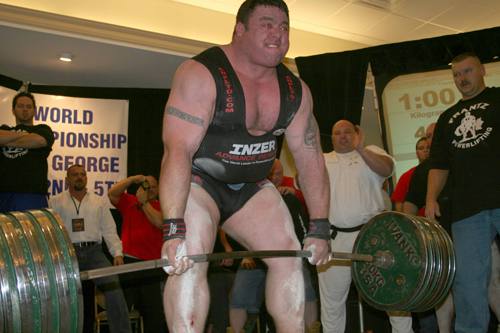
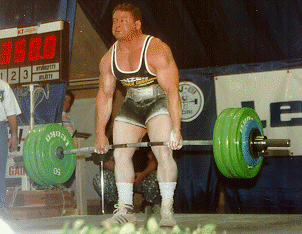
Our culture's attitudes to diet and exercise are fucked up. While this probably isn't news to many people, I've recently had the lesson hammered home in an unexpected way. A few months back I decided to take up regular exercise for the sake of both my mental and physical well-being. So far, so normal. This page on exercise, from the NHS website, contains a vast array of articles concerning the benefits of exercise and how to exercise: everything from jogging to Nordic walking to tai chi. The problem is that I didn't want to do some kind of safe, moderate cardio or stretching. I took up something not mentioned on the NHS's exercise page, or even in their "What's Your Sport?" personality test: powerlifting. It's pretty much perfect for me: I don't have to "work as a team" or even talk to anyone if I choose not to, I don't have to run anywhere, I can just put in my headphones, turn on some death metal, and lift something heavy until my muscles beg for mercy. I get a nice Zen-like concentration going, I get a post-workout high, and after a heavy day with the iron I sleep like a baby. Meanwhile, I'm stronger than I've ever been in my life, I have muscles where no muscles were before, and I have something to look forward to and feel good about afterwards. Point is, it's good for me. It's doing what I wanted exercise to do.
The "problem" is that, in order to succeed at powerlifting, you have to gain muscle. It's no coincidence that the best powerlifters are muscular as fuck. And in order to gain muscle, you have to gain weight. That's where the problem lies insofar as the uninitiated are concerned, because the prevailing view in our culture is that exercise and weight loss are inextricably linked. The top string predicted by Google for "workout to" is "workout to lose weight". For "exercise to", "exercise to lose weight" is third, and the top result is a Youtube video is an exercise video teaching people to lose belly fat (the impossibility of spot reduction be damned). Exercise to gain muscle, apart from "grow lolhuge biceps in three days using this one weird trick", or "get six-pack abs fast (which is really about weight loss anyway) is given comparatively short shrift. Physical activity is aimed squarely at weight loss rather than improving physical performance. Our culture apparently aims to turn out people with a BMI of 18-22, regardless of whether or not they can run five miles or lift their own bodyweight.
So what I'm aiming for, deliberate weight gain, is weird. Abnormal. Practically heretical. I'm "eating myself into obesity". My high-protein diet is "disgusting". I'm "bloating up". Even members of my own family assume that my physical pursuits must be unhealthy, purely because I've gained weight by doing them. And it isn't just me. See, for example, the abuse that dogged British Olympic weightlifter Zoe Smith (and her awesome response to it). This is, of course, an area in which women have it tougher: building muscle is even less acceptable for them than it is for men. But the direction in which this should all point is towards a healthier physical culture, one that focuses on physical performance (and individual measures such as body fat percentage rather than population measures like BMI) over numbers on a scale that often tell you little about someone's health and well-being.
Thursday, 25 October 2012





Wednesday, 26 September 2012
Sex, Lies, and Wishful Thinking At Dawn
This summary is not available. Please
click here to view the post.
Monday, 10 September 2012
He-sluts and She-sluts
This is interesting. According to a survey of American college students, men are judged just as harshly for having many sexual partners as women are. Of those polled, 12% answered yes to the question “if (wo)men hook up or have sex with lots of people, I respect them less” for women, and 13% for men. A few facts from the article stood out to me:
That said, it's just one article, based on one survey from perhaps the most sexually screwed-up culture in the Western world. Drawing too many conclusions might be dangerous. But given that most complaints about the sexual double standard come from that very same culture, it's still worth a look. I'm interested to see any other responses to this study. And if accurate, it's also a kick in the teeth to the feminists that see the sexual double standard as a patriarchal method for controlling women.
- There is no quantification of "lots of people". While it seems likely that each respondent would use the same definition of "lots of people" across the two questions, there were a significant number of people who lost respect for one sex but not the other. Those two groups may not have the same idea of what constitutes "lots of people". Second, there's no quantification if how much respect is lost. If slutty men get the occasional side-eye while slutty women get the occasional stoning-to-death, there's still a pretty substantial double standard. But the article doesn't go into that.
- Men are apparently judged marginally more harshly than women for hooking up with too many people. Given sex-positive commentary on the slut/stud dichotomy, this is a little surprising. After all, aren't men supposed to be congratulated for having lots of different partners while women are pilloried? The article linked doesn't go into why this might be, but as an unscientific guess based purely on anecdotal evidence I'd say that it's because men with a high number of previous partners are judged as "players" by women: likely to cheat, emotionally detached, and potentially predatory. While the article doesn't say as much, given the discrepancy between men and women in judging women, it seems likely that the group judging men negatively is largely female.
- Only 6% of women lose respect for women who've had sex with lots of people. This seems odd, given how much they slut-shame each other.
- American college students are a pretty conservative bunch. Only 27% of those polled didn't judge anyone negatively for having a high number of sexual partners. And as this article notes, this "egalitarian libertarian" attitude is more common among non-heterosexual students, indicating that heterosexual students are even more conservative than the overall figures. Over half of women will negatively judge anyone with a high number of partners.
- While double standards are rare overall, it's fairly common so long as you're negatively judging the other gender. A quarter of men held the traditional double standard. While the figures are not broken down for the reverse double standard, given the rest of the article it seems likely that this is primarily held by women. People suck.
- At the top of the social hierarchy, double standards abound. Male athletes and fraternity members were far more likely to hold the traditional double standard than other men (38% and 37%, compared to 25%). The reasons why are unexplored in the article, which means that it's conjecture time. My guess? High-status men are unlikely to judge male promiscuity negatively because they're getting more pussy than anyone else on campus. It would also go some way towards explaining why women think that the traditional double standard is so prevalent: people listen more to the men at the top of the social hierarchy than the men at the bottom.
That said, it's just one article, based on one survey from perhaps the most sexually screwed-up culture in the Western world. Drawing too many conclusions might be dangerous. But given that most complaints about the sexual double standard come from that very same culture, it's still worth a look. I'm interested to see any other responses to this study. And if accurate, it's also a kick in the teeth to the feminists that see the sexual double standard as a patriarchal method for controlling women.
Fifty Shades Of Missing The Point
This summary is not available. Please
click here to view the post.
Women write sex blogs for fun. Men do it for darker reasons.
It isn't often that you can say that what a debate really needs is greater representation of the heterosexual, cisgendered, male perspective. So I was sort of surprised last night when I heard this on BBC Radio 4. Novelist and broadcaster Sarah Dunant gave a short talk making exactly that argument. Empirically speaking, there's something in it. A search of the Guardian's (a politically and culturally liberal newspaper, likely to have more commentary on sex than most of its competitors) Comment is Free section found 64 articles related to "sex" within the last 30 days. While a few of the returned articles were written by men, this was more due to the Guardian's poor search function than anything else: most related to gay marriage or the Julian Assange trial. Articles about sex and gender, with the exception of one piece on male circumcision, were written exclusively by women. A look at Wikipedia's list of notable sex columnists reveals a few male names, not least Dan Savage, but it's still very female-dominated. The Sex and Relationships section of Alternet: female-dominated. And in the kink blogosphere, women once again rule the roost. While male sex bloggers do exist, they tend to either come from a feminist perspective, to be hopelessly self-flagellating, or both.
On the surface, this appears strange. We ostensibly live in a culture in which male sexuality is celebrated and female sexuality shamed, the stud/slut dichotomy. But while pseudonyms are common online (Clarisse Thorn, Bitchy Jones, Belle de Jour before she went public), there are plenty of women writing about sex under their own names. And while the popularity of the #mencallmethings hashtag indicates that this isn't entirely without hazard, "shaming" doesn't seem to have stopped them. Obviously these represent a fairly narrow subset of women: educated, middle-class, etc. But while this might resolve the apparently conflict between the "shaming" theory and the fact that women do in fact write candidly about their own sex lives and sexuality in general, it doesn't answer the question of why men of similar backgrounds don't get in on the act.
In fact, the reason is fairly simple. Men and straight male sexuality are presented as predatory, as shirking responsibility, as sexually unsatisfying to the point at which women should all become lesbians, as patronisingly paternalistic, as dangerous, as a justifiable barrier to political office. Even the radio piece that inspired this article is hardly complimentary: despite the subject of how men have been excluded from the sex debates, it still reads as a laundry list of male crimes against women. The only men mentioned in the piece, in fact, are George Galloway, Ken Clarke, Todd Akin, and a naked Californian doctor, all included as either sexual abusers or apologists for sexual abuse.
It's time for something different, a viewpoint that doesn't treat men and male sexuality as pathological. That isn't to say that this blog will focus relentlessly on those issues, more that it will be part of the underlying ethos. Honestly, it'll probably be a fairly light, irregularly updated look at BDSM, sex, and anything cultural or social that I care about enough to write about. It's more about filling a gap in the market, about writing something that wouldn't make someone like me feel browbeaten. But I think that's a worthy enough goal.
On the surface, this appears strange. We ostensibly live in a culture in which male sexuality is celebrated and female sexuality shamed, the stud/slut dichotomy. But while pseudonyms are common online (Clarisse Thorn, Bitchy Jones, Belle de Jour before she went public), there are plenty of women writing about sex under their own names. And while the popularity of the #mencallmethings hashtag indicates that this isn't entirely without hazard, "shaming" doesn't seem to have stopped them. Obviously these represent a fairly narrow subset of women: educated, middle-class, etc. But while this might resolve the apparently conflict between the "shaming" theory and the fact that women do in fact write candidly about their own sex lives and sexuality in general, it doesn't answer the question of why men of similar backgrounds don't get in on the act.
In fact, the reason is fairly simple. Men and straight male sexuality are presented as predatory, as shirking responsibility, as sexually unsatisfying to the point at which women should all become lesbians, as patronisingly paternalistic, as dangerous, as a justifiable barrier to political office. Even the radio piece that inspired this article is hardly complimentary: despite the subject of how men have been excluded from the sex debates, it still reads as a laundry list of male crimes against women. The only men mentioned in the piece, in fact, are George Galloway, Ken Clarke, Todd Akin, and a naked Californian doctor, all included as either sexual abusers or apologists for sexual abuse.
It's time for something different, a viewpoint that doesn't treat men and male sexuality as pathological. That isn't to say that this blog will focus relentlessly on those issues, more that it will be part of the underlying ethos. Honestly, it'll probably be a fairly light, irregularly updated look at BDSM, sex, and anything cultural or social that I care about enough to write about. It's more about filling a gap in the market, about writing something that wouldn't make someone like me feel browbeaten. But I think that's a worthy enough goal.
Subscribe to:
Comments (Atom)